Nuclear energy for India: safe path to clean power or too risky?
Nuclear energy GD topic: India's 8,780 MW today, the 100 GW target for 2047, the SHANTI Act, safety data and cost, with points for and against.
This topic asks whether India should build many more nuclear power plants to get clean electricity, or whether the risks are too high. Nuclear power is electricity made from the heat of splitting uranium atoms inside a reactor. It gives no smoke and almost no carbon dioxide while running, but it brings the risk of an accident and the problem of radioactive waste.
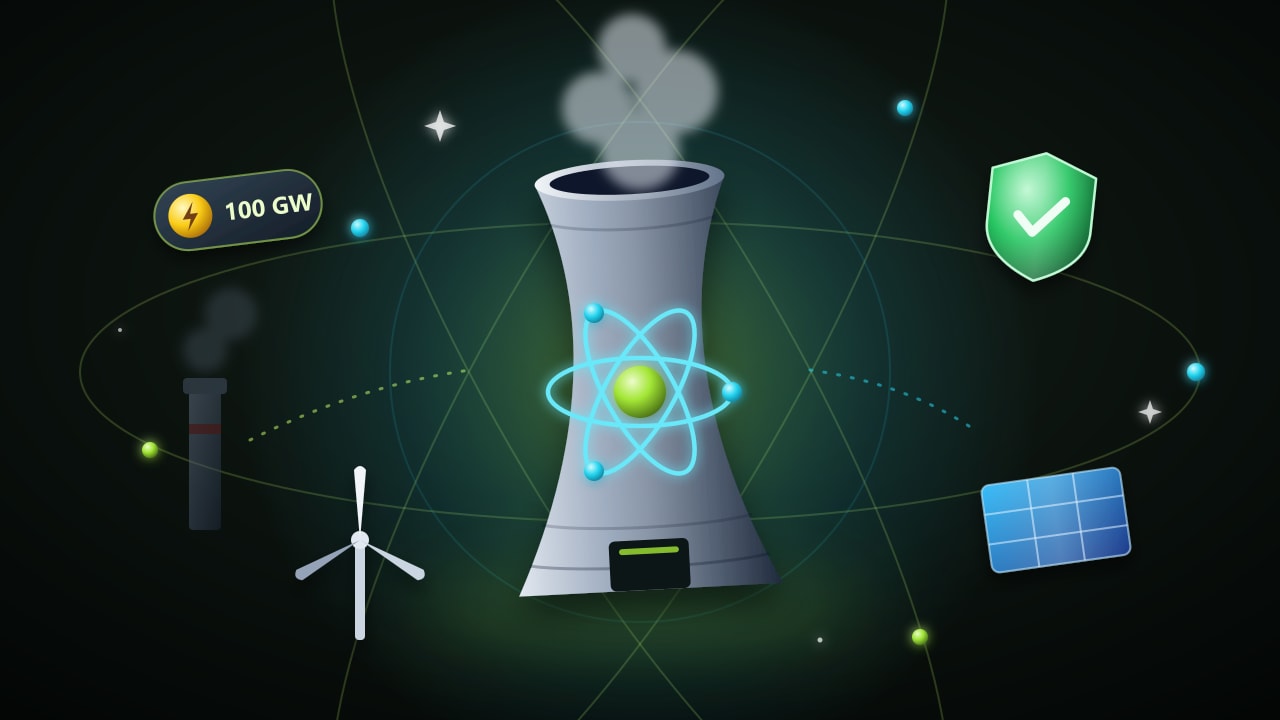
The topic is in the news because the law has just changed. In December 2025 Parliament passed the SHANTI Act, which lets private companies take part in India's nuclear sector for the first time. The government also wants 100 GW of nuclear capacity by 2047, which is more than ten times what India has today.
Background
The Department of Atomic Energy says India had 8,780 MW of installed nuclear capacity in February 2026. That is up from 4,780 MW in 2014. A Lok Sabha reply of July 2025 says nuclear plants generated 56,681 million units in 2024-25, which was a 3.1% share of India's electricity.
The government's plan is to reach 22,380 MW by 2031-32. After that it wants 47 GW by 2037, 67 GW by 2042 and 100 GW by 2047. Eighteen reactors totalling 13,600 MW are at some stage of building or preparation. The Union Budget 2025-26 also set aside ₹20,000 crore for a Nuclear Energy Mission, which aims to have at least five Indian-designed small modular reactors working by 2033.
The SHANTI Act repeals the Atomic Energy Act of 1962 and the Civil Liability for Nuclear Damage Act of 2010. It lets private firms run plants and make equipment. It also gives the regulator, the Atomic Energy Regulatory Board, a statutory footing. The liability of the plant operator is capped at ₹100 crore for small plants and ₹3,000 crore for large ones. The old rule that let operators claim against equipment suppliers is gone.
On safety, Our World in Data counts deaths per unit of electricity. Its 2022 update gives 0.07 deaths per terawatt-hour for nuclear, including Chernobyl and Fukushima, against 24.6 for coal. The widget below turns the 100 GW target into reactors per year, so you can judge how realistic it is.
Points in favour
These points support the view that nuclear power is a safe path to clean power.
- It gives steady power with almost no carbon. A reactor runs day and night, unlike solar and wind, which depend on weather. India targets net zero by 2070, and a firm clean source helps replace coal in the evening and at night.
- The safety record per unit of power is good. Our World in Data puts nuclear at 0.07 deaths per terawatt-hour, counting 433 deaths from Chernobyl and 2,314 from Fukushima. Coal causes 24.6, mostly from air pollution.
- India has a large share to gain. Nuclear is about 3% of India's electricity today, so even a modest rise would cut coal use. The government plans to take capacity to 22,380 MW by 2031-32, which is more than double.
- India builds its own reactors. The 700 MW pressurised heavy water reactors at Kakrapar and Rawatbhata are Indian designs, and RAPP-7 reached full power on 10 February 2026. This lowers dependence on imported technology.
- The new law brings in money and speed. The Nuclear Energy Mission and the SHANTI Act aim to add private capital and small modular reactors. Public funds added only 4,000 MW from 2014 to 2026, so reaching 100 GW needs a much faster pace.
Points against
These points support the view that nuclear power is too risky or too slow.
- Accidents are rare but very costly. Chernobyl and Fukushima showed that one failure can empty whole districts for years. India is densely populated, so a similar accident could affect a very large number of people.
- The liability rules are weaker now. The SHANTI Act caps operator liability at ₹3,000 crore for large plants and removes the supplier clause. A petition before the Supreme Court says this encourages manufacturers to cut corners. The court adjourned the matter in February 2026 without a ruling.
- Plants are slow to build. The CAG found that commercial operation of Kudankulam units 1 and 2 came 86 and 101 months late. A target of 100 GW by 2047 needs a pace that India has not yet shown.
- Waste and local opposition remain unsolved. Spent fuel stays dangerous for a very long time, and protests at Kudankulam delayed the first unit by several years. Families near a site carry the risk, while the power goes to the grid.
- The scale is small beside the cost. Nuclear is about 1.7% of India's installed power capacity. Critics ask whether the same money would give more clean power faster through solar, wind and storage.
Opening the discussion
You can open with a fact. "Nuclear gives India about 3% of its electricity. The government wants 100 GW by 2047, so the question is whether we can grow it safely." This works when the group is slow to start, because it sets the size of the debate.
You can open with a comparison. "Our World in Data counts 0.07 deaths per terawatt-hour for nuclear and 24.6 for coal. So the real choice may be nuclear or coal, not nuclear or nothing." This works when the group has strong fears, because it adds a number to the argument.
You can open with a question to the group. "If an accident is rare but very costly, who should pay: the operator, the supplier or the government?" This works when you want to bring up the SHANTI Act early.
Concluding the discussion
A good conclusion names the strongest point on each side and then gives conditions. Most groups end at "yes, with safeguards", and that is fine if you say which safeguards.
"We heard that nuclear power gives steady, low-carbon electricity with a good safety record per unit. We also heard that accidents are costly, plants are late and the liability rules are being tested in court. So nuclear can be part of India's clean power mix, if the regulator is independent, the liability rules are clear and the projects are finished on time."
Facts worth quoting
| Fact | Figure | Source and year |
|---|---|---|
| India's installed nuclear capacity | 8,780 MW, up from 4,780 MW in 2014 | Department of Atomic Energy, February 2026 |
| Nuclear's share of electricity | 3.1% in 2024-25 | Lok Sabha reply, July 2025 |
| Official target | 100 GW by 2047, with 22,380 MW by 2031-32 | Department of Atomic Energy, February 2026 |
| Small modular reactors | ₹20,000 crore, at least five by 2033 | Union Budget 2025-26 |
| SHANTI Act | Passed by Parliament in December 2025 | World Nuclear News, 2025 |
| Operator liability cap | ₹100 crore to ₹3,000 crore by plant size | Reports on the SHANTI Act, 2026 |
| Deaths per terawatt-hour | 0.07 for nuclear, 24.6 for coal | Our World in Data, 2022 |
| Kudankulam units 1 and 2 delay | 86 and 101 months | CAG audit, 2017 |
Mistakes to avoid
- Saying nuclear power has no risk. Even supporters accept that accidents and waste are real. Say instead that the risk per unit of power is low and must be managed.
- Mixing up capacity and output. 100 GW is installed capacity, which is not the same as the electricity actually generated. A reactor does not run at full power every hour.
- Treating the SHANTI Act as settled. A petition before the Supreme Court challenges parts of it. Say that the liability rules are being tested, not that they are final.
- Comparing nuclear with solar on cost alone. Solar is cheap per unit, but it works only when the sun shines. Compare what each source gives at night and at peak hours, too.
Practise group discussion
Reading won't make you fluent. Book a group discussion and practise speaking in a group. You will get a detailed feedback report after the session.
Book a group discussion