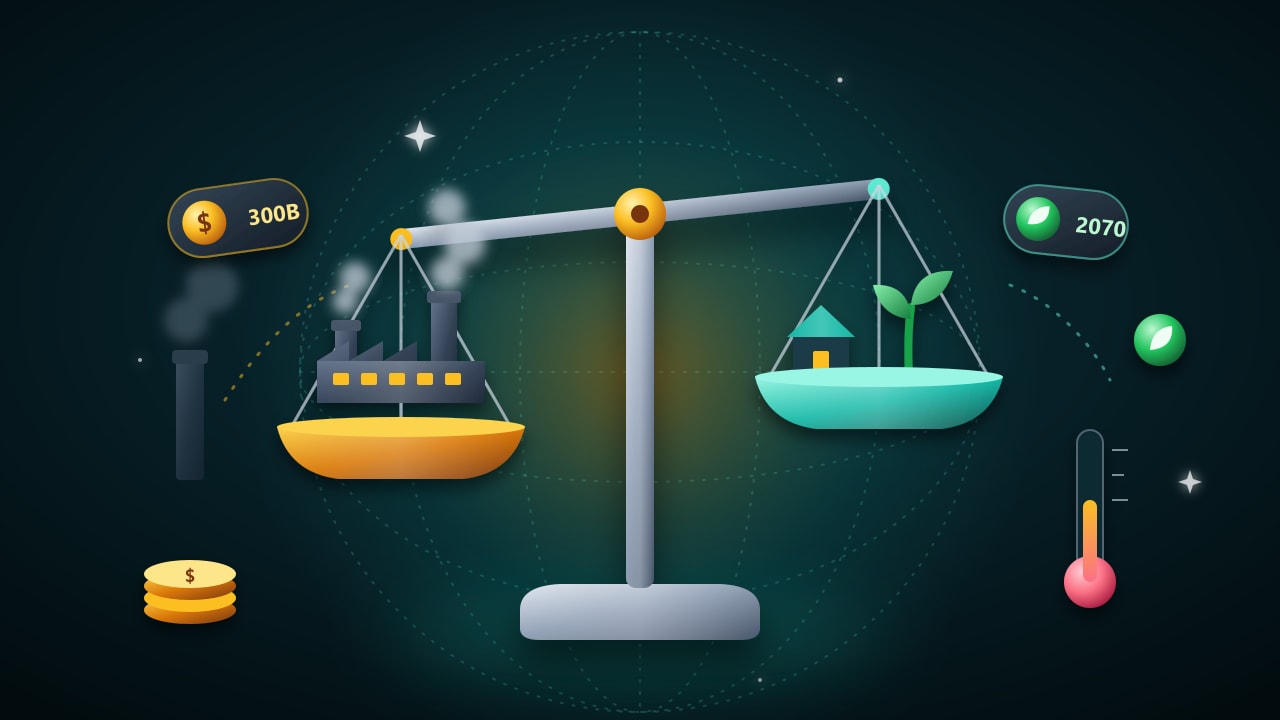
Climate change: should developed countries carry more responsibility than developing ones?
Climate responsibility GD topic: who has emitted most, what the $300 billion climate finance goal means, India's position, and points for and against.
This topic asks whether rich countries should do more than poor countries to deal with climate change, in cutting emissions and in paying for the damage. Developed countries are the richer, industrialised ones. The United States, the United Kingdom, Germany and Japan are examples. Developing countries are the poorer ones that are still building roads, power plants and cities, and India is one of them.
The topic is in the news because the money question is still open. At COP29 in Baku in November 2024, countries agreed that developed countries would take the lead on at least $300 billion a year of climate finance by 2035. Developing countries had asked for much more. Then the United States left the Paris Agreement, which took effect on 27 January 2026.
Background
The idea that responsibility is shared but not equal has a name, common but differentiated responsibilities. It is written into the UN climate convention of 1992. It says all countries must act. The countries that caused more of the problem and have more money must do more.
The numbers behind the idea are easy to find. Our World in Data uses the Global Carbon Budget. It says the United States is responsible for 24% of all fossil CO2 since 1750 and China for 15%. The same source puts India at 3.57%.
Today's picture is different. The EU's EDGAR database says China emitted 29.2% of the world's greenhouse gases in 2024, the United States 11.1% and India 8.2%. So the biggest emitter today is not a developed country. That is the main argument of those who say responsibility should be shared more equally.
Per person, the gap is wide again. EDGAR puts the United States at 17.5 tonnes of CO2-equivalent per person in 2024, China at 11.1, the EU at 7.06 and India at 3.11. The world average is 6.63. The widget below lets you count responsibility three ways and see how the ranking changes.
On money, developed countries promised in 2009 to mobilise $100 billion a year by 2020. The OECD says they reached $115.9 billion in 2022, two years late. At COP30 in Belem in November 2025, countries agreed to try to triple adaptation finance by 2035. Developed countries gave $26 billion for adaptation in 2023, against a need of $310 billion a year.
Points in favour
These points support the view that developed countries should carry more responsibility.
- They caused most of the carbon already in the air. Carbon stays in the atmosphere for a long time. The United States alone accounts for 24% of fossil CO2 since 1750, so today's warming is largely a result of their growth.
- They can afford to pay. The principle of common but differentiated responsibilities rests on capability as well as history. A country with a high income can fund clean power and still grow, while a poorer country has to choose between the two.
- Ordinary people in poor countries emit very little. An average Indian caused 3.11 tonnes of greenhouse gases in 2024, compared with 17.5 for an American. Asking both to cut by the same amount treats unequal lives as equal.
- Poor countries suffer the most. The figures reported at COP30 say developing countries need about $310 billion a year for adaptation by 2035. They have the least money to build sea walls, cooling shelters and crop insurance.
- Rich countries made a promise and were late. The $100 billion pledge was due in 2020 and was first met in 2022, the OECD says. This is why developing countries ask for firm public finance, not loans or private money.
Points against
These points support the view that responsibility should be shared more equally.
- The biggest emitters today are not all developed. China emitted 29.2% of global greenhouse gases in 2024 and India 8.2%, EDGAR says. The atmosphere does not care where a tonne came from, so cuts have to come from the countries that emit most now.
- Future growth will come from developing countries. The Global Carbon Budget 2025 projects India's fossil CO2 to rise 1.1% in 2025, while the EU's falls 0.1%. If these countries follow the old coal path, the world cannot stay within its temperature limit.
- Historical blame is hard to pin on today's people. Someone born in 2005 did not choose the factories of 1900. Many argue that responsibility should look forward, to who can cut emissions cheapest now, and not backward.
- Rich countries are slow to pay and some are leaving. The United States exited the Paris Agreement on 27 January 2026. If the promised money is uncertain, some argue, developing countries must plan cuts on their own.
- Developing countries are already doing their part. PIB says India reached 50% non-fossil installed power capacity in June 2025, five years early. This shows poorer countries can act even when the finance falls short.
Opening the discussion
You can open by defining the principle. "The UN climate convention says responsibility is common but differentiated. That means everyone acts, and those who caused more must do more." This works when the group is unsure where to start, because it frames the whole debate.
You can open with a contrast of numbers. "An average American is responsible for 17.5 tonnes of greenhouse gases a year. An average Indian is responsible for 3.11." This works when you want an early, memorable point.
You can open with a question to the group. "If China is now the largest emitter, does history still matter, or only what each country does from today?" This works when you want to bring in both sides at once.
Concluding the discussion
A good conclusion names the strongest point on each side. Then it gives a position that uses both: a larger share of the cost for developed countries, and real cuts from every large emitter.
"We heard that developed countries caused most of the carbon already in the air and can afford to pay. We also heard that the largest emitters today include developing countries. So developed countries should carry more of the cost and cut first. Every big emitter, including India, should also have a clear public plan to cut."
Facts worth quoting
| Fact | Figure | Source and year |
|---|---|---|
| US share of cumulative fossil CO2 since 1750 | 24% | Our World in Data, from Global Carbon Budget 2024 |
| India's share of cumulative CO2 since 1751 | 3.57% | Our World in Data, 2024 data |
| Greenhouse gases per person, US and India | 17.5 and 3.11 tonnes CO2-equivalent | EDGAR, 2024 |
| Share of global greenhouse gases, China, US, India | 29.2%, 11.1%, 8.2% | EDGAR, 2024 |
| First year developed countries passed $100 billion | $115.9 billion in 2022 | OECD, May 2024 |
| New climate finance goal | At least $300 billion a year by 2035, led by developed countries | COP29, November 2024 |
| Adaptation finance gap | $26 billion given in 2023, about $310 billion a year needed by 2035 | COP30 reporting, November 2025 |
| India's non-fossil share of installed power capacity | 51.93% | PIB, 31 December 2025 |
Mistakes to avoid
- Mixing up total and per person. India is the third largest emitter in total, but a low emitter per person. Say which one you mean, or a panel member will correct you.
- Treating developing countries as one block. China, India and Bangladesh have very different emissions and incomes. Name the country when you give a number.
- Blaming a single country. Talk about rich and poor countries, and about the rules and the money, so the discussion stays on policy and not on the United States or China.
- Saying India does nothing. India has a 2070 net zero target and passed 50% non-fossil power capacity in 2025. Skipping this makes the argument one-sided.
Practise group discussion
Reading won't make you fluent. Book a group discussion and practise speaking in a group. You will get a detailed feedback report after the session.
Book a group discussion